Arctic Cruises
Expeditionary cruising is a very practical way to discover the Arctic, allowing you to comfortably explore often untouched areas of wilderness you can’t otherwise reach from …
Discover More
Some people assume the Arctic is an empty, frozen void, but its history is the story of human ambition. For many thousands of years, indigenous cultures learned to master this icy realm, long before European navigators raced to find the mythical Northwest Passage. The High North is a fascinating archive of human triumph and tragedy.
Karl ONeill Arctic Sales Specialist
Special Offers:Swoop has access to the widest range of offers and can help you find the right trip, cabin, & price.

This popular introduction to Svalbard is keenly priced and, with numerous early season departures, guarantees plenty of ice. Sail onboard one of the newest ships in polar waters and spot bears from the plentiful deck space. Optional kayaking and hiking…

Maximise wildlife sightings with the chance to circumnavigate Spitsbergen island. Search for walrus, arctic fox, whales and of course the ‘King of The Arctic'. Sail through the Hinlopen Strait and visit abandoned trapping stations and experience glaciers up close all…

Circumnavigate Spitsbergen on board on a comfortable expedition ship and in the company of specialist guides. Travelling on a smaller ship allows you more time to explore, and some late-season departures benefit from stunning autumn light. Ask about special guest…

Experience the Arctic’s legendary wildlife aboard an intimate micro expedition ship, amidst a pristine backdrop of calving glaciers, and snow-capped mountains. With an unmatched sense of ‘expedition’ and a deeper connection to nature, you build your own adventure, searching for…

Embark on this epic fly and cruise 11- or 12-day expedition into the wildest, least visited corner of Greenland, which combines the labyrinthine Scoresbysund fjord system with the vast Northeast Greenland National Park. By day, navigate spectacular fjords and pass…

An intimate summer expedition circumnavigating Spitsbergen on a 12-guest micro ship. Feel connection to nature, with a sense of solitude and scale, which is harder to find on larger ships. Explore rarely-visited islands, glaciers and the polar desert in search…

Reach the top of the world in serious comfort onboard a state-of-the-art luxury, hybrid-powered icebreaker. Travel north through icebound waters and join the exclusive list of intrepid explorers who have visited the geographical North…
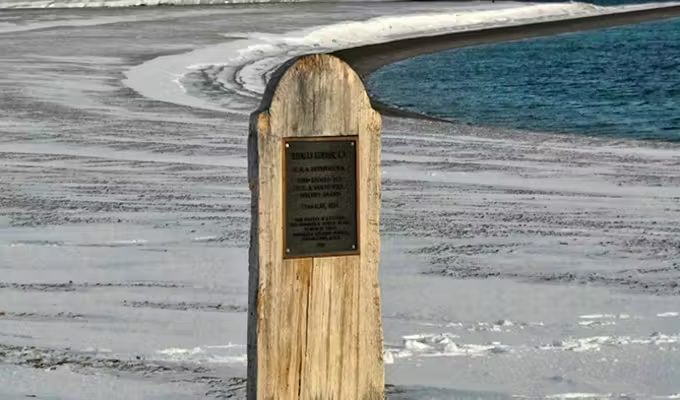
The big ice and small towns of West Greenland provide a stunning start to this trip before you sail across the Davis Straight to Baffin Island and enter the Northwest Passage. Blend history, scenery and wildlife; pay your respects at…
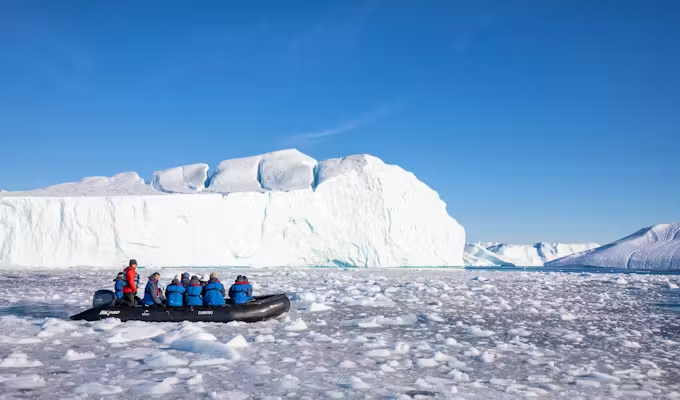
Beginning in Cambridge Bay, this westbound-arching route encapsulates the best that the Northwest Passage and West Greenland have to offer. Thread your way through the icy labyrinth of staggering landscapes, dramatic history, remote Inuit settlements and charismatic Arctic wildlife, with…
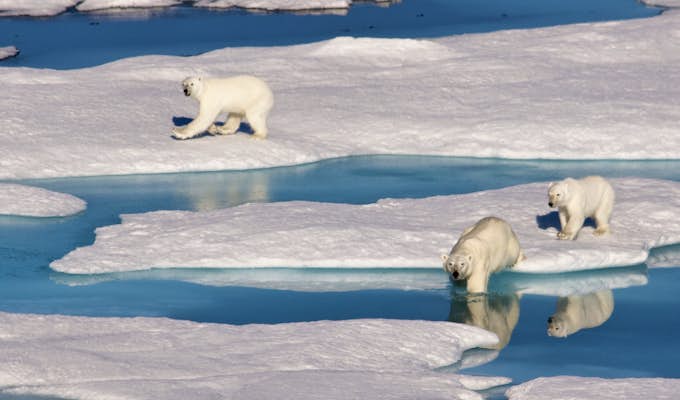
In the labyrinthine icy channels of the legendary Northwest Passage, explore the islands and channels that form Canada’s High Arctic region. Meet local indigenous people, encounter enigmatic Arctic wildlife – including walruses, beluga whales, polar bears, musk oxen and the elusive…
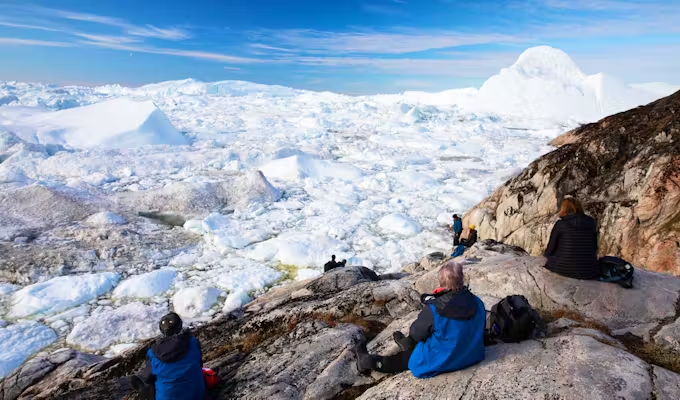
A full transit of the Northwest Passage is a truly epic undertaking, travelling in the footsteps of legendary explorers Amundsen, Franklin and Larsen. This voyage is distinguished by the small, nimble and comfortably appointed expedition ship you'll travel on, with…
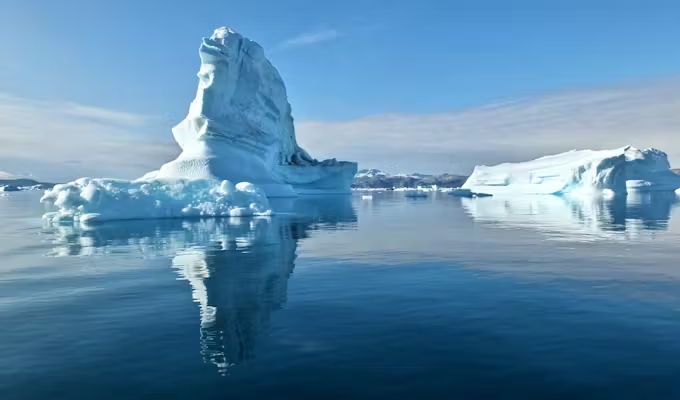
Beginning in Svalbard before sailing west across the Greenland Sea and exploring Greenland’s long eastern coastline to finish in Iceland, this is an audacious Arctic journey of startling diversity and contrast. Spectacular landscapes, towering glaciers and once-in-a-lifetime wildlife encounters all…
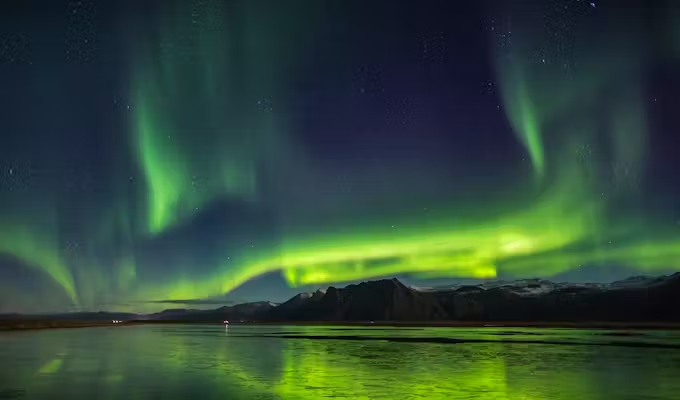
Sailing in August or September, explore the massive fjords of East Greenland and their legendary icebergs, spot musk oxen and visit ancient and modern Inuit settlements. Late summer provides a great chance of spotting the Northern Lights. A choice of…
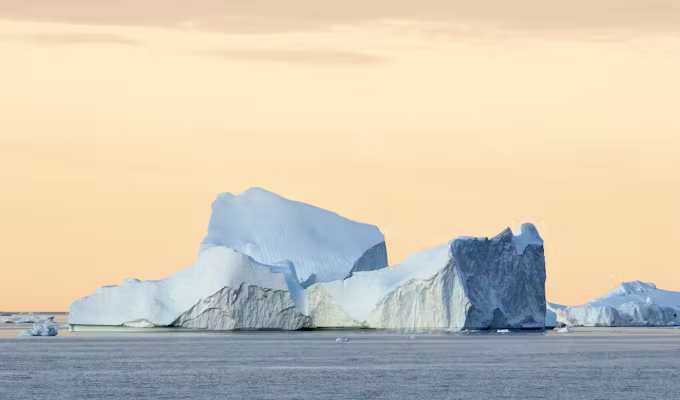
This might be a short trip but it packs a huge amount in. Sail among the ice of Disko Bay and spot humpbacks hunting herring; trek to the look out over Jakobshavn Glacier; explore the settlements of Sisimiut and Itilleq…
Discovered by Dutch explorer Willem Barentsz in 1596, Svalbard – then Spitsbergen, meaning 'pointed peaks' – quickly became a whaling hub.
After the whales were decimated, Norwegian trappers hunted Arctic foxes, before the islands became a launchpad for daring North Pole expeditions, including Roald Amundsen’s 1926 flight.
Coal mining later brought permanent settlements and shaped Svalbard’s economy for over a century. Soviet miners also created a thriving community at Pyramiden. Today, historic cabins, towns and expedition sites remain.

The old coal industry in Ny-Ålesund
For centuries, explorers sought the elusive Northwest Passage through the Arctic, facing ice, failure and tragedy.
Martin Frobisher, James Cook and others made early attempts, while post-Napoleonic expeditions by John Ross, William Parry and John Franklin mapped vast reaches of the region.
Franklin’s 1845 expedition ended catastrophically, claiming all 129 lives. Robert McClure completed the first transit in 1853, but Roald Amundsen achieved the first full passage by ship, aboard Gjøa, between 1903 and 1906.

Leopold Island, home to thousands of thick-billed murres
Beyond my expectations, and I would recommend unreservedly. Read the full review
Travelled: November 2018
Val Chiswell - United Kingdom
Once again, Swoop’s service and advice were immaculate. The fact that we are returning clients says it all! Read the full review
Travelled: August 2018
Charles & Lesley Cook - United Kingdom
Kayaking in the thick brash ice by a big glacier, on a beautiful sunny day was a highlight....but then again, so was when the walrus popped its head up out of the water right in front of me when in the zodiac! Read the full review
Travelled: June 2018
Leslie & Nancy Steenbeke (Grossman) - United States Of America
We were really lucky with sightings; saw polar bears on four occasions, blue whales twice, lots of fin whales and about 70 beluga whales in an hour on one day, as well as a couple of lovely white arctic foxes and a few walruses.
Travelled: August 2017
Declan - UK
Greenland’s story stretches back 2,500 years to the Paleo-Eskimo Saqqaq and Dorset cultures, followed by the Thule people, ancestors of today’s Inuit. Norse Vikings, led by Erik the Red, arrived in the 980s, making settlements that endured for centuries.
Danish-Norwegian colonisation began in 1721, and Greenland became fully integrated into the Danish Realm in 1953. Since gaining Home Rule and Self-Government, Greenland has increasingly shaped its own future.
Today, climate change and strategic Arctic resources have renewed global interest.

Locals share their culture
For centuries a myth, the North Pole became the focus of intense exploration in the early 1900s. American explorers Robert Peary and Matthew Henson claimed to reach 90° North in 1909, though their claim remains contested. The first undisputed arrival occurred in 1926, when Roald Amundsen flew over the pole in the airship Norge. The Soviet Union achieved the first verified landing in 1948 using three aircraft.
During the Cold War, the pole evolved into a vital strategic zone as nuclear submarines, starting with the USS Nautilus in 1958, routinely patrolled beneath the ice. Today, melting ice driven by climate change continues to fuel intense geopolitical rivalry.

Forging a path through the ice
The history of the Arctic is an epic saga of human survival, tragedy and untamed ambition. Scratch the icy surface of this region and you're sure to find something that will draw you in further.
Expeditionary cruising is a very practical way to discover the Arctic, allowing you to comfortably explore often untouched areas of wilderness you can’t otherwise reach from …
Discover More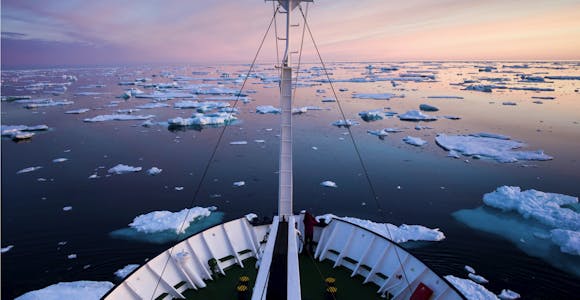
We partner with selected ice-strengthened Arctic expedition vessels from small yachts and nimble little ships with convivial atmospheres, to larger Russian research boats and …
Discover More
Choosing to visit the Arctic is the easy part, but what can you expect to do and see once you arrive? From daily zodiac safaris, guided shore landings, insightful lectures and …
Discover More
The Arctic is one of the most diverse wildlife habitats on Earth, harbouring a vast array of animals adapted to the extreme cold. Polar bears and walrus can be spotted on the sea …
Discover MoreFor over 20,000 years, indigenous peoples have lived in the Arctic. Early cultures, like the Paleo-Inuit (Dorset culture), were the first to adapt to the extreme environment and were eventually succeeded by the Thule culture around 1000 CE.
They are the direct ancestors of modern Inuit populations now spread Alaska, Canada, and Greenland.
The Northwest Passage is a sea route that connects the Atlantic and Pacific Oceans via the archipelago of the Canadian Arctic.
European powers sought this route for centuries in order to establish a lucrative, direct trade route to Asia without sailing around South America or Africa.
In 1845, Sir John Franklin led two ships, HMS Erebus and HMS Terror, to navigate the final unmapped sections of the Northwest Passage.
Both ships became trapped in ice near King William Island, resulting in the death of all 129 crew members. The shipwrecks were finally discovered in 2014 and 2016.
American explorer Robert Peary claimed to reach the North Pole in 1909 alongside Matthew Henson and four Inuit men, but his claim remains disputed by modern historians.
Roald Amundsen was the first verified person to reach the North Pole in 1926 by airship. Wally Herbert reached the North Pole on foot in 1969.
During the Cold War, the Arctic became a strategic frontline between the United States and the Soviet Union because it offered the shortest nuclear missile flight paths between the two superpowers.
This era also saw heavy militarisation, including radar lines (like the DEW Line), nuclear submarine patrols under the ice, and permanent air bases.
We'll spend some time listening to your aspirations, then discuss the kind of experience that might suit you.
Next we'll discuss the options, shortlist the best trips for you and present you our impartial recommendations.
We'll place a 24 hour hold on your preferred option - without obligation - whilst we talk through the details.