
Canadian Arctic Cruises
Sandwiched between Alaska and Greenland, Canada’s ‘Far North’ covers a whopping 39% of the country’s total land area, yet is populated by less than 1% of the population. …
Discover More
For an opportunity to spot six of the Arctic's most iconic wildlife on one trip, the Canadian Arctic is a perfect destination. The wildlife may be scattered widely across this vast and isolated region, but you will be in the company of experts who will know the signs to look out for and the best places for sightings.
Alex Mudd Head of Swoop Arctic

The eastern entrance to the Northwest Passage, particularly in and around Lancaster Sound, is the summer home to one of Canada’s largest clusters of polar bears.
They congregate here as the sea ice melts and are also attracted by migrating beluga whales and narwhal – popular prey and a veritable feast for a hungry bear.
Migrating with the whales in a southwest direction, by July and August polar bears can be found around Somerset and Prince of Wales Island. Then as autumn sets in and the ice starts to reform, bears retrace their steps back northeast towards Lancaster Sound and out into Davis Strait.
The best bear sightings are typically when they’re amongst ice where they feel safest; when on land they tend to move away quickly.
Well known places for polar bears include Coningham Bay, Lancaster Sound, Croker Bay and Bellot Strait.

Polar bear with whale carcass
Although they resemble bison these rather strange looking animals are actually very large goats, weighing up to 900lbs. With impressive horns and enormous shaggy coats they are an iconic Arctic species that like to feed on the rolling tundra in small family groups. Their name is derived from the musky odour emitted by males to attract partners during the mating season.
Although the world population is estimated at just 150,000 about three quarters of musk oxen are to be found in the central Canadian Arctic and Greenland. In the Northwest Passage region, Devon, Victoria, Prince of Wales and King William Islands all provide good sighting opportunities, with one of the highest concentrations of these curious creatures to be found on Banks Island. They can swim, so could be present on any of the islands in the region.

A herd of musk oxen wander the landscape
With its blubbery brown hide, long tusks and bushy whiskers, the walrus always makes an impressive and endearing sight.
These creatures favour the shallow waters of bays and coves of the Northwest Passage where they dredge up large quantities of marine molluscs, shrimps, worms and crabs.
Weighing up to a ton, they must consume about 6% of their own body weight in food every day.
Between meals they like to rest on land or ice in large social groups called 'haul outs' where they bellow and snort at one another.
Although these slightly comical creatures are rarely found to the west of Bellot Strait, they tend to be a frequent sight around the Devon and Bathurst Islands.

Walruses hauled out on the ice
With its distinctive white skin, bulbous head and permanent fixed grin, the beluga whale is a delight to behold.
Social, gregarious and playful, individuals and large pods will happily come close to ships, zodiacs and kayaks.
Pods of up to 150 strong have been seen in these waters.
Concentrations of these whales can be found around glaciers and in shallow bays, with popular ‘hot spots’ along the Northwest Passage at Cunningham Inlet, Coningham Bay, Cornwallis Island and the northern coast of Somerset Island.

Viewing belugas from the boat
This rotund black whale, which grows to 60ft in length, is one of the few Arctic species that remains in these waters year round.
Once hunted for oil, meat and baleen, the Baffin Bay and Davis Strait population has recovered well, now numbering as many as 16,000 (three times that of the late 1970s).
Research suggests that bowhead whales are the longest-lived mammal on earth with a lifespan of up to 200 years. One whale was discovered to have a 130-year-old harpoon embedded in its neck.
They also boast the largest mouth of any creature on earth, which they use to scoop up and filter huge quantities of plankton.
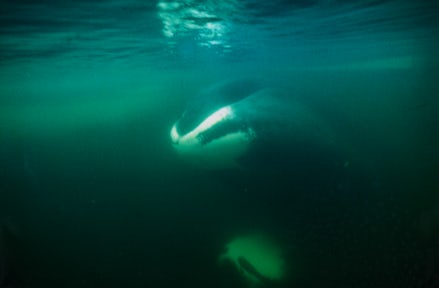
Bowhead whale
This medium-sized whale is remarkable for its single long tusk which can grow to an excess of two metres – a feature that has secured it a special place in mythology.
Some believed the tusk to be a unicorn horn complete with magical powers. This air of mystery is heightened by the fact that the narwhal is incredibly shy (even being spooked by air bubbles from scuba divers).
Only occasionally spotted from ships, it is most commonly sighted at the edge of ice floes.
The north coast of Baffin Island and Lancaster Sound are some of the best places in the world in which to see narwhal.

A pod of narhwals
This region is a bird watcher’s paradise as countless species, and millions of birds, nest and hatch their young here every summer.
The list is extensive, from ptarmigans, guillemots, puffins, auks and terns to kittiwakes, fulmars, eider ducks and the arctic skuas.
The limestone cliffs of Prince Leopold Island host 400,000 birds, including 100,000 pairs of thick-billed murres, while Bylot Island provides nesting habitats for a staggering 74 bird species.
Keen birders should note that by September, with temperatures dropping, the majority of the migratory birds have departed south for warmer climes.

Birds gather on an iceberg near Akpatok Island
In the Arctic, patience, sharp eyes, and knowing where to look all play their part. The search and anticipation are a key part of the experience.
Sandwiched between Alaska and Greenland, Canada’s ‘Far North’ covers a whopping 39% of the country’s total land area, yet is populated by less than 1% of the population. …
Discover More
Exploring by expedition ship delivers unmatched access to the Canadian Arctic’s secluded shores, frozen passageways and isolated settlements. Considering the vast expanses and …
Discover More
Access to the Canadian Arctic is limited to just two months a year: August and September. It's only in these months when temperatures are above freezing and the ice has receded …
Discover More
The Canadian Arctic is vast and remote, with few roads, limited airports and no public coastal ferry services connecting communities. For visitors wanting to explore beyond the …
Discover MoreYes, there are. And these experts - each a specialist in their own particular field - are the backbone of the ship’s team, as they are your accompanying guides, interpreters and presenters.
While each expedition team is different and the individuals rotate around, you can definitely expect there to be a polar historian, glaciologist, local community guide, ornithologist and cetacean specialist on your voyage.
Expedition teams are each led by an Expedition Leader and they are typically between 13 and 30 guides, depending on the size of the ship and number of guests.
There are three main variables - alongside luck, which none of us can control - to bare in mind when it comes to giving yourself the best chance of seeing polar bears:
1. Length of trip: Put simply, the longer your trip the greater your chances of wildlife encounters
2. The Itinerary: While polar bears are very nomad, there are well-known polar bear ‘hotspots’ (e.g. Coningham Bay, Lancaster Sound, Croker Bay and Bellot Strait)
3. Calibre and size of the expedition team: You want a big and very experienced team, as that means there will always be lots of sets of eyes on watch for wildlife. And, secondly, from experience, they’ll also know where to look, which will further improve your chance of successful sightings
The twin main focuses on any Northwest Passage trip will be the wildlife and history of the region.
Throughout your voyage, expedition staff will be on constant lookout for wildlife and the day’s schedule is purposely flexible to make the most of any encounters.
Plus, along with visits to places of historic interest and local communities, your itinerary is planned around including visits to a number of the known wildlife 'hotspots'.
This is a tricky question to answer as there’s always a slice of luck involved when it comes to wildlife sightings. However, in our experience, smaller ships have a higher chance of better wildlife sightings because:
When it comes to landings, this is where having fewer guests on board carries a distinct advantage as it means:
Yes, all of these optional activities are offered. If you are interested in specific ones, check carefully as each ship offers a slightly different activity programme.
Hiking, the Polar Plunge and photography workshops are all complimentary. Kayaking quite often carries an extra cost, which we can help advise you on.
Please note that paddle boarding, camping and scuba diving are not available on any ship.
This is a really important question as it ascertains the ease of access you’ll have to the onboard experts within the expedition team, and how much 1-2-1 time you can expect when it comes to answering your questions.
The ships with the highest guide-to-guest ratios in the Canadian Arctic are: